AI is advancing rapidly. How can organizations keep pace?
In an article published today, Cezar Taurion draws attention to an important contradiction: artificial intelligence models evolve at an extraordinary speed, while many organizations still struggle to transform this potential into sustainable economic results.
I agree with this analysis. And I would like to add a perspective: to overcome this gap, it is not enough to accelerate AI adoption. We need methods capable of transforming the very functioning of organizations.
Companies are incorporating LLM models, agents, and intelligent tools. However, automating isolated activities does not necessarily mean creating new organizational capabilities.
The real challenge is to transform technological possibilities into integrated agentic capabilities, oriented towards business purposes and results.
It is to face this challenge that we are developing and applying the integral agentic design method.
The method combines two complementary movements.
The bottom-up approach allows us to understand and explore the evolution of LLM models, intelligent agents, turing bots, and other technological components;
The top-down approach starts from organizational purposes to conceive the capabilities, services, and cooperation processes necessary for transformation.
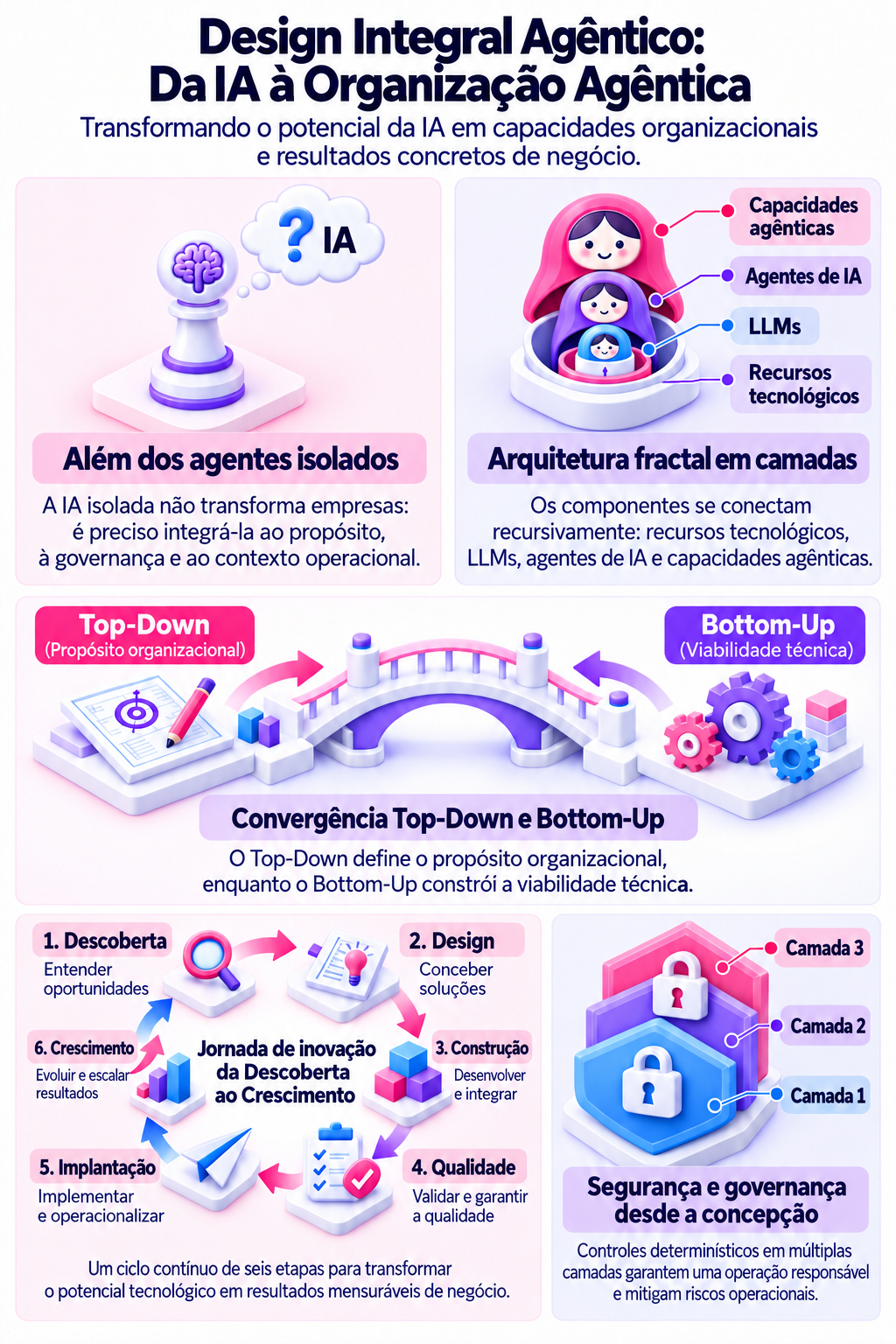
These movements meet in a fractal architecture, which connects the agentic organization to its agentic capabilities, to the turing bots, and to the intelligent components that perform its functions.
This approach has its roots in Sysware Theory, presented by Per-Arne Mannby in 1988, which distinguishes the functional structure from the physical structure and establishes the mapping between them. In integral agentic design, this foundation gains an application focused on organizations that incorporate artificial intelligence.
The method follows a continuous journey of discovery, design, build, QA, and growth: understanding reality, conceiving transformation, realizing the solution, verifying its results, and promoting its evolution.
The decisive aspect lies precisely in this continuity.
As LLM models evolve, organizations need to be able to update and expand their agentic capabilities, incorporating new technological possibilities without relying on isolated initiatives or improvised transformations.
This also requires the participation of professionals, the integration between human knowledge and artificial intelligence, and governance mechanisms designed from the outset.
Transformation does not simply consist of doing the same things faster. It consists of conceiving new ways of producing value.
It is this vision that guides our agentic transformation journey at Squadra and its application in our clients' organizations.
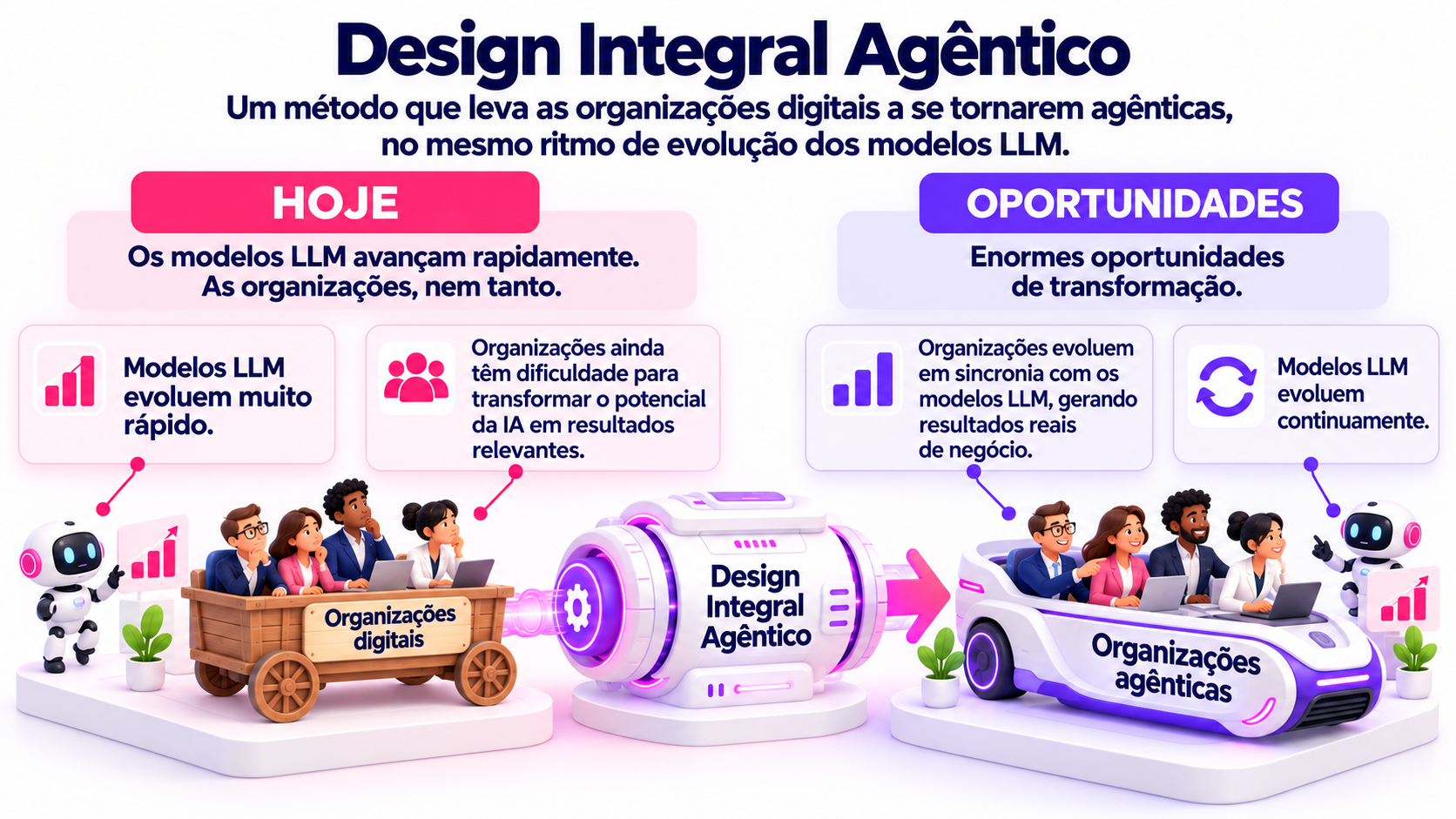
The image accompanying this article seeks to represent this change: today, LLM models advance rapidly, while many organizations are left behind. Integral agentic design is our proposed method to reduce this gap and create conditions for continuous evolution.
Cezar Taurion is right to point out that technological evolution, by itself, does not guarantee business transformation.
Our contribution is to add an answer to the question that this diagnosis provokes:
How can organizations evolve at the pace of LLM models?
We believe the answer involves a method capable of integrating purpose, architecture, technology, people, and continuous evolution.
This is the proposal of integral agentic design.
Read also, in Portuguese, on LinkedIn.