The new era of knowledge production
There is a common characteristic among all the great transformations produced by humanity. None of them began in physical reality; all of them began in intelligence.
Before a bridge existed, it existed as a project. Before a city was built, it existed as a plan. Before a new medicine saved millions of lives, it existed as a scientific hypothesis. Before an organization was transformed, it existed as a shared model of future reality.
This observation seems simple, but it is perhaps one of the most important laws of science and engineering.
Every transformation happens twice: first, as the production of knowledge; then, as the transformation of reality.
This is the essence of design.
Design as a projection of future reality
Over the past few decades, the term design has been primarily associated with the development of products, interfaces, or experiences.
In this article, we will use a broader definition:
Design is the intellectual activity by which intelligences consciously project a future reality before it exists.
This future reality is not yet physical. It does not yet operate. It does not yet produce value.
But it already exists objectively.
It exists in models.
This is perhaps the main responsibility of intelligence: to project possible futures.
The future is born before implementation
It is common to imagine that innovation happens during implementation.
In reality, implementation merely materializes what has already been conceived.
Innovation is born earlier. It is born when we can deeply understand the present reality and imagine a future reality capable of eliminating pain points, meeting needs, and producing new values. At that moment, the transformation has already begun.
There is no software yet. There are no processes yet. There are no platforms yet.
But there is already knowledge.
Artificial intelligence changes the scale of this process
Artificial Intelligence extraordinarily expands our ability to observe patterns, simulate alternatives, synthesize information, and accelerate analysis.
However, it does not eliminate the need for design. On the contrary, the greater the computational capacity, the more important it becomes to correctly decide which reality we want to build.
AI expands possibilities. Design chooses the future.
This distinction will become increasingly important.
Collective intelligence
Contemporary challenges have become too large to be solved by isolated individuals. Transforming a railway, a healthcare system, a company, a city, or a logistics chain requires dozens or hundreds of specialists.
Each observes different aspects of the same reference. No individual intelligence can comprehend the entire reality. The solution becomes collective.
Thus, a new form of intelligence emerges: collective intelligence.
Hybrid collective intelligence
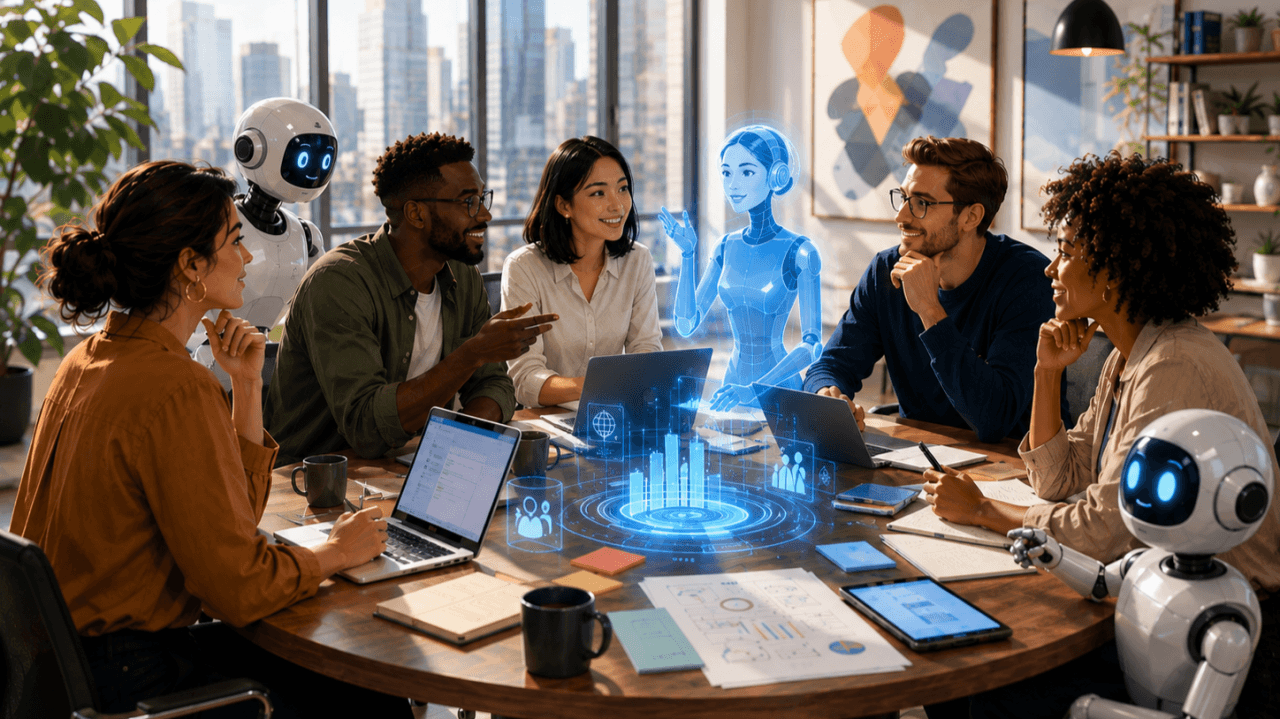
The Age of Artificial Intelligence adds a new participant to this process. In addition to people, we now also count on artificial intelligences. Not as substitutes, but as amplifiers of human capacity. Human experts: architects, designers, researchers, executives, users.
And artificial intelligences begin to cooperate continuously during the production of knowledge.
This cooperation inaugurates what we will call hybrid collective intelligence.
Perhaps this is the main organizational innovation of the AI Era.
Integral design
But cooperation does not happen spontaneously.
A method, a common language, a shared architecture are necessary.
This is precisely the mission of integral design.
Integral design organizes the collective production of knowledge. Its objective is not just to imagine solutions. It is to build a shared vision of future reality.
When this vision becomes common to all intelligences involved, cognitive convergence is born. And only then can the transformation begin.
Before software, there are models
All implementation depends on models.
Models make explicit the reality we wish to build. They allow us to discuss, validate, refine, experiment.
Without any physical implementation yet existing.
Integral design transforms implicit knowledge into explicit knowledge.
These models become the first objective existence of future reality.
Genius
At Squadra, this process is carried out by the Genius platform.
Human experts cooperate continuously with turing bots throughout the entire cycle of discovery, design, build, testing, and evolution.
The turing bots belong exclusively to Squadra's internal architecture; they are strategic assets of our own organizational intelligence.
Their purpose is to expand our capacity to deeply understand clients' reality and project high-quality transformations.
The client never receives the turing bots; they receive something much more valuable.
A new organizational architecture.
The true product of transformation
Historically, we imagined that technology companies delivered software.
Today, we believe this is no longer true.
Software is just a means. The true product is a new organizational capability.
This capability begins to operate continuously within the organization.
In the AI Era, these capabilities may be implemented by agentic twins.
Each agentic twin represents a specific capability designed during integral design. It remains in the organization long after the project ends.
Thus, each transformation no longer delivers just technology; it delivers permanent organizational intelligence.
Human responsibility
Perhaps the greatest change brought about by Artificial Intelligence is also the most paradoxical.
The more capable our technologies become, the greater our responsibility becomes.
Because the problem ceases to be technological and becomes epistemological.
We need to decide what reality we want to build. What values we want to produce. What capabilities we want to develop.
AI expands our ability to execute, but it is still human intelligence that chooses the future.
Read also on LinkedIn.