
Beyond the Big Bang: The 4 Entry Points of the Genius AI Modernization Journey
The biggest myth of digital transformation is that every legacy system requires a complete rebuild from scratch. Strategic decisions based on the premise of a big bang, which involves discarding years of accumulated business rules to rewrite the entire architecture, often result in blown budgets, operational paralysis, and failure to deliver ROI.
Executive reality demands pragmatism.
The main bottleneck for established companies is not a lack of innovation vision, but the accumulation of technical debt that ties up cash flow, increases maintenance costs, and hinders operational agility.
Modernization can no longer be a binary choice between “maintaining an obsolete system” or “assuming incalculable operational risk”.
The end of generic approaches with AI applied in a modular and adaptable journey
Traditional IT has become accustomed to treating modernization as a homogeneous product. However, attempting a complete overhaul for a critical system that only needed its integrations adjusted destroys budget efficiency.
Similarly, applying lift-and-shift to a monolith whose biggest problem is its business rules merely transfers operational inefficiency to a newer platform, increasing TCO (Total Cost of Ownership).
The Genius AI Modernization journey breaks away from the rigidity of traditional projects.
Instead of imposing a single path, the strategy is based on four distinct entry points. The starting point is determined exclusively by the business's technical maturity, timing, and operational urgency, allowing for customization of the offering without fragmenting the long-term vision.
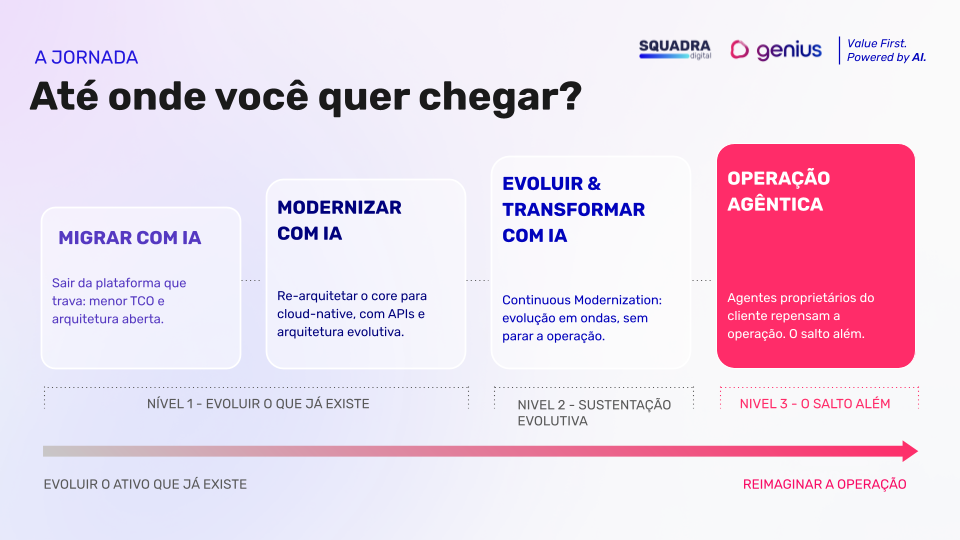
The 4 entry points of Genius AI Modernization
1. Migrate with AI: risk reduction
This entry point focuses on drastically reducing TCO and replacing obsolete or proprietary technologies. It is indicated for scenarios where licensing costs are suffocating the budget or where the current infrastructure limits market adherence.
Capabilities: re-platforming, technological migration, and transition from black boxes to open and cloud architectures;
Engineering application: AI agents read pipelines, analyze dependencies, and extract business rules to accelerate the transition securely;
Business impact: autonomy over the technological stack, elimination of vendor lock-in, and significant reduction in delivery times and costs.
Use case with Genius
A large global insurance company maintained its cloud infrastructure on an obsolete platform, leading to increasing costs per transaction and technical dependence on third parties. The goal was to migrate from a third-party integration platform (outsourced iPaaS) to Microsoft Azure, but validation required proving the portability of complex flows with conditional rules and sensitive data transformation.
Squadra applied accelerated reverse engineering with Genius's AI agents (turing bots), performing semantic analysis and business rule extraction in a few hours. After this process, the flow was natively rebuilt in Azure Functions and Azure Storage, with full fidelity to the original rules.
2. Modernize with AI: untangling what is critical
Focused on coupled monoliths and legacy systems that hinder business growth and depend on a few key individuals.
Capabilities: structural refactoring of the core, modularization (APIs and evolutionary architectures), data model restructuring, and UX/UI redesign;
Engineering application: AI documents legacy code without history, maps couplings, and assists in rewriting to cloud-native standards;
Business impact: transformation of legacy systems into a scalable platform, retention of corporate knowledge, and elimination of the risk of lacking qualified professionals.
3. Evolve & transform with AI: continuous modernization without big bang
Developed for mission-critical operations that cannot suffer interruptions or undergo risky downtime windows.
Capabilities: wave-based evolution, modernization of critical integrations (APIs and event-driven architectures), and evolutionary maintenance with intelligence;
Engineering application: dedicated teams using AI for preventive diagnostics and continuous observability in production, identifying integration failures before they become incidents;
Business impact: constant and friction-free technological evolution, keeping systems running 24/7 while technical debt is progressively reduced.
Use case with Genius
A major railway logistics operator ran on a train circulation control system developed over a decade ago, containing more than 300,000 lines of code and zero technical documentation.
Genius's AI agents (turing bots) instrumented the source code and analyzed runtime logs to decode the system from the inside out. Subsequently, the turing bots performed a massive code translation to a current microservices-oriented and cloud-native architecture language.
In the end, the code's complexity was reduced by 70%, and from discovery to deploy, after undergoing detailed comparative execution tests, the entire process took only 90 days, with all users migrated and zero critical operational incidents.
4. Agentic operation: the leap beyond modernization
The most advanced entry point rethinks the entire operational process. The legacy system is no longer just modernized but orchestrated by an autonomous intelligence layer.
Capabilities: end-to-end functional re-engineering, agentic automation with generative AI, and construction of proprietary platforms orchestrated by agents;
Engineering application: extraction of regulatory and business rules for the creation of proprietary agents capable of making decisions and executing complex tasks;
Business impact: scaling operational capacity by eliminating manual bottlenecks, transforming legacy systems into data-driven strategic assets.
Use case with Genius
Operation Smile, a global volunteer medical organization with a presence in over 60 countries, faced severe operational bottlenecks with manual patient data collection in spreadsheets, international language barriers, physical forms, and lack of internet connectivity during the screening of children's cleft lip surgeries.
Squadra, using its proprietary AI platform, Genius, developed an intelligent ecosystem with multi-language support, offline functionality, and generative intelligence for screening and visual data analysis. The result was much faster screening, completed in minutes, a 90% reduction in translation errors, and rapid report generation to support medical decisions.
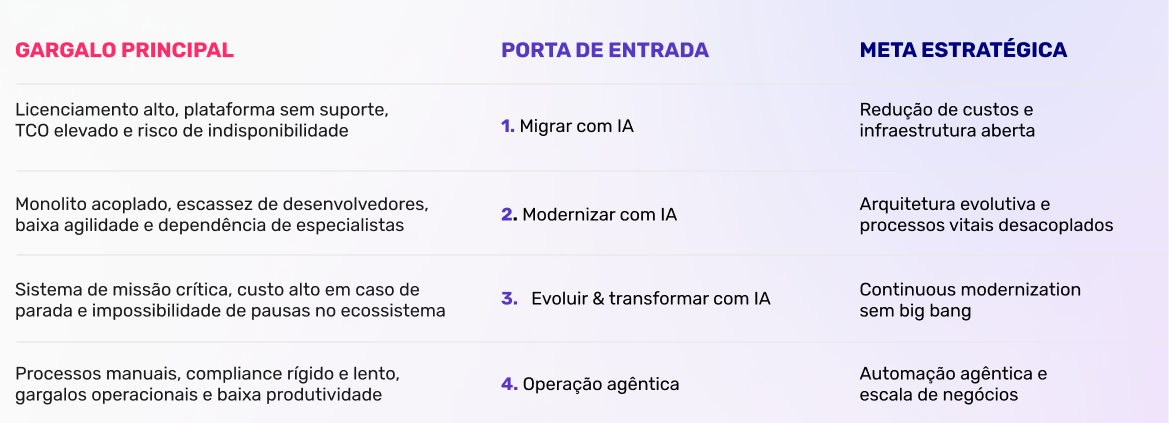
How to determine the entry point according to the business moment?
For technology leaders, choosing the correct entry point should follow an objective diagnosis of the current business and operational scenario:
The future of legacy modernization
System modernization no longer has a finish line; it has become a continuous software engineering capability.
The competitive advantage of the next decade will not belong to those who have the newest code written from scratch, but to those who can orchestrate AI to extract value from their software assets with the lowest TCO, controlled risk, and maximum agility.
Want to discover which door your company needs to enter today to ensure its survival and relevance tomorrow? Talk to our specialists.
Learn more about the Genius AI Modernization journey, go beyond the big bang, and transform your business into an agentic operation.