

How to build an end-to-end AI-orchestrated martech ecosystem?
There is a common mistake in the market: viewing generative artificial intelligence as an isolated tool for creating email copies or generating images faster. This fragmented approach not only creates massive technical debt but also fails to move the revenue and operational efficiency needles.
While leadership celebrates isolated wins, the real pipeline remains blocked by data silos, untraceable digital assets, excessive time-to-market for new products, and conversion journeys with friction that drain business margins.
AI applied to the martech ecosystem is not a content generator; it is a continuous layer of orchestration, optimization, and governance that must connect everything from data infrastructure to the final conversion point.
The fragmented martech trap
The traditional marketing technology ecosystem was built in disconnected layers. Companies invest millions in complex stacks of DXP, CMS, e-commerce platforms, and experimentation tools, but daily operations remain hostage to manual bottlenecks:
Untraceable digital assets: repositories full of duplicate assets, without clear taxonomy and brand compliance, requiring weeks to launch a campaign;
Decentralized data: inconsistency across digital channels, stretching content lifecycle and reducing ROI;
Passive search and optimization: legacy search engines within platforms that do not understand real user intent, coupled with content that ignores the evolution of LLMs (Large Language Models);
Conversion friction: fragmented purchase and conversion journeys that require users to access multiple platforms and/or channels to complete a transaction.
The consequence of this scenario is high maintenance costs, loss of organic visibility, and stagnant conversion rates. What can be done to change this?
The fluid journey of orchestrated marketing
True digital transformation in marketing requires replacing isolated tools with an articulated ecosystem built on three integrated operational pillars:
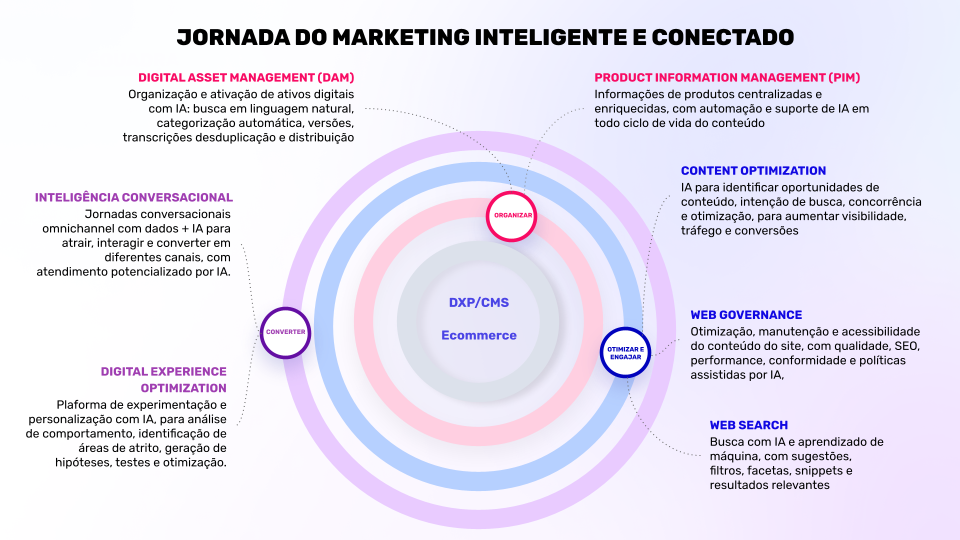
AI acts as the backbone of this entire ecosystem, automating processes that previously took weeks and ensuring real-time responses to potential customer behavior.
The three pillars of high-performance martech architecture
1. Organize: consolidation and intelligent management of data and assets
The foundation of any successful AI and martech strategy is the hygiene and accessibility of brand and product data. Without a centralized base, recommendation and generation algorithms operate in the dark.
AI-powered Digital Asset Management (DAM)
Implements intelligent repositories with automatic tag marking, natural language search, and deduplication. The direct result is a reduction in campaign launch time by up to 2x, 100% brand compliance, and doubled ROI through asset reuse.
Automated Product Information Management (PIM)
Centralizes the product lifecycle (descriptions, technical specifications, and media). AI automation simplifies data synchronization across multiple digital channels, reducing manual tasks and optimizing listing scale for retail.
2. Optimize and engage: visibility and governance in the era of AI search engines
As consumer search patterns shift from traditional Google to conversational LLM interfaces, content optimization needs to evolve from keywords to information architecture focused on intent.
Content optimization for LLMs
Adapts existing content inventory using artificial intelligence to align brand tone of voice, analyze competitor gaps, and measure Content Score before publication. This ensures higher CTR (Click-Through Rate) and organic visibility in both traditional search engines and generative AI responses.
Native web search with machine learning
Eliminates the rigid internal search experience by implementing AI models that offer dynamic facets, auto-correction, and suggestions based on user history, which increases engagement and retains traffic within the company's digital properties.
Continuous web governance
Enables AI-assisted governance policies to actively scan the website for quality errors, performance bottlenecks (Core Web Vitals), SEO flaws, and accessibility issues (WCAG - Web Content Accessibility Guidelines).
3. Convert: experimentation and conversational intelligence in the customer channel
Modern conversion does not happen on the conventional landing page; it occurs in the channel where the user prefers to interact.
Digital Experience Optimization (DXO) with AI agents
Replaces rudimentary A/B testing with integrated suites that use intelligent automation to analyze heatmaps, identify funnel friction points, automatically formulate hypotheses, and generate variations of pages and mobile apps in real-time.
End-to-end conversational platforms
Reduces reliance on traditional e-commerce checkout and implements omnichannel journeys that use generative AI to understand purchase intent, recommend products within WhatsApp, and allow customers to complete payments without leaving the conversation.
Integrated platforms have been shown to reduce average response time by 33% and decrease the overflow rate to human agents by over 70%.
The agile execution model
Implementing an end-to-end integrated martech ecosystem without paralyzing current operations is possible by structuring the journey into well-defined phases:
Discovery & blueprint: maps the current customer journey, identifies operational bottlenecks, and defines the opportunities with the highest immediate ROI (Return on Investment);
Service and experience design: redesigns touchpoints considering fluid integration between DAM, PIM, CMS (Content Management System), and conversational channels;
AI-enabled development: utilizes specialized squads in the implementation of modern platforms to accelerate deployment time;
Optimization and growth: establishes a continuous cycle of CRO (Conversion Rate Optimization), behavioral testing, and data refinement to scale conversion results.
The transition to an intelligent marketing ecosystem is an architectural and operational redefinition.
Executives who continue to treat AI as a one-off individual productivity resource will see their teams suffocated by inefficient operations and high acquisition costs. On the other hand, organizations that structure AI as a fluid layer of governance, automation, and end-to-end conversion will dominate industry engagement and economic results.
How integrated and agile is the infrastructure supporting the entire customer journey? Talk to our specialists to understand how to orchestrate your business's martech ecosystem.