
How to decide between specialized models and LLMs? Jev and the rise of System One Models
At the current stage of corporate maturity, artificial intelligence has surpassed the experimental phase of laboratory prototypes. The main challenge for technology and business leaders today is value engineering and governance: how to scale intelligent solutions without creating operational bottlenecks or unpredictable cloud bills that hinder ROI.
Over the past few years, the market has adopted an almost monocultural stance: when faced with any problem involving text or unstructured data — whether classifying a message, extracting metadata, routing a technical ticket, or assessing risk — the standard response was to plug in the API of an LLM (Large Language Model).
However, in high-volume, continuously repetitive corporate scenarios, the use of general-purpose LLMs reveals severe architectural flaws: high latency, cumulative costs of input and output tokens, and the fragility of systems that need to interpret responses in plain text.
It is in this friction-filled scenario that a new architectural class emerges: System One Models, led by Jev, developed by Typesafe AI, and Laya, its open-source counterpart.
At Squadra, where artificial intelligence governance is the foundational basis of the Genius AI platform, we deeply explore how this technical transition alters companies' business decisions and budgets.
What is Jev and the concept of System One?
To understand Jev, it is useful to recall the cognitive psychology theory formulated by Daniel Kahneman about the human mind:
System 1: fast, automatic, instinctive, and low-energy mental operations (recognizing a facial expression, dodging an obstacle, classifying a stimulus in fractions of a second);
System 2: slow, deliberate, computationally costly, and conscious reasoning (solving a complex calculation, writing a critical essay, drafting a contract).
Traditional LLMs and recent logical reasoning models attempt to replicate System 2 or act as large discourse generators. They operate auto-regressively, calculating the probability of the next sequence, which is costly in terms of computational power and time.
Jev is designed to act strictly as System 1 for corporate AI.
Typesafe AI defines the model as a frontier intelligence call function: it consumes free, unstructured text, but does not return conversation. It directly returns structured, typed decisions calibrated with mathematical rigor.
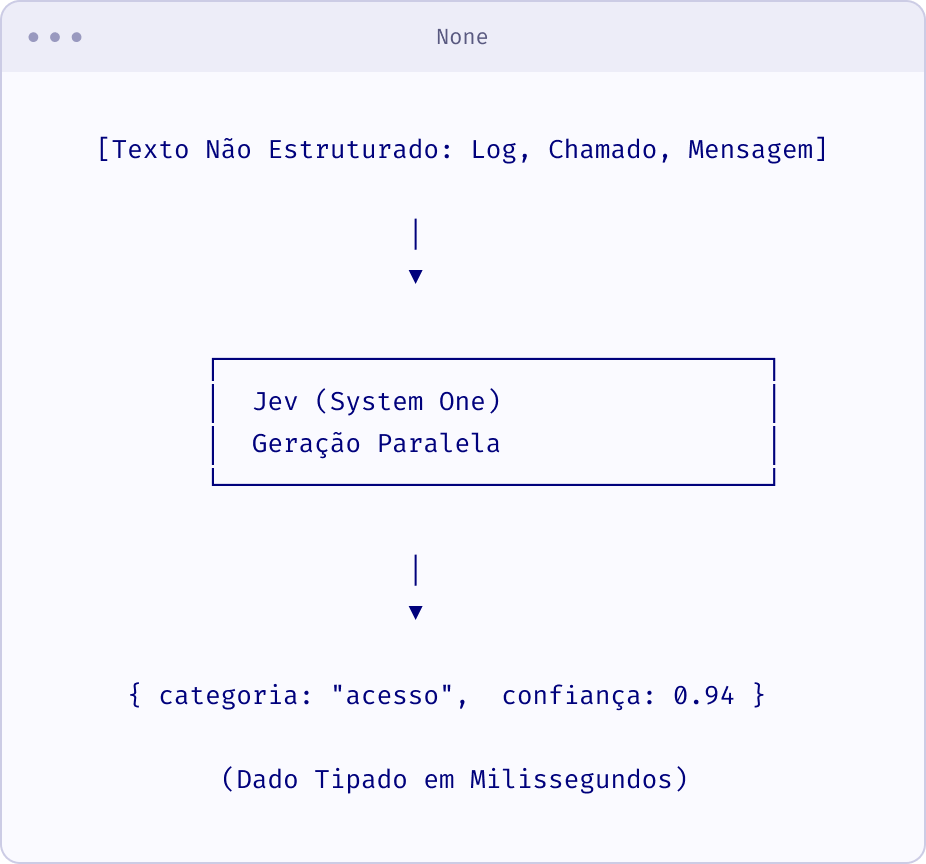
Jev's foundation rests on three technical pillars:
1. Typed output and the end of parsing
In integrations with traditional LLMs, developers spend continuous effort on prompt engineering to force the AI to respond in JSON or XML. Even with constrained decoding techniques, the model still generates text strings that need to be validated by code parsers. If the LLM adds a stray word or breaks the syntax, the automation stops and requires retries.
In Jev, possible results are defined via a schema before inference. The return is natively typed, eliminating fragile layers of data sanitization.
2. Calibrated probabilities via RLCD
One of the biggest dangers of LLMs in automated decision-making is confident hallucination: the model can err grotesquely while maintaining a tone of absolute certainty.
Jev introduces a proprietary training method called RLCD (Reinforcement Learning for Calibrated Decisions). The focus of this approach is not to teach the model to sound convincing, but to ensure that the probability associated with the response corresponds to factual reality. If Jev indicates a confidence score of 0.85 for a classification, the historical statistical accuracy rate for that range should indeed approach 85%.
3. Parallel inference (end of token-to-token)
Conventional LLMs suffer from latency because they generate responses word by word: token n depends on the calculation of all previous tokens.
Jev processes extraction and decision in parallel in a single query. This shifts inference speed from the range of several seconds to the level of 70 ms to 500 ms, enabling real-time transactional flows.
Jev vs. Laya: the issue of lock-in and open models
Just as Jev emerges in the proprietary model under early access, the ecosystem has seen the rise of Laya, presented as an open-source alternative. For corporate architectures, the choice between a managed API solution and an open model has direct governance implications:
Jev
It delivers SaaS operational simplicity and infrastructure optimized by the provider, but carries risks of vendor lock-in and uncertainties regarding future pricing after the launch period.
Laya (open source)
It offers data sovereignty, absence of third-party request fees, and the possibility of running on proprietary infrastructure (on-premises or private cloud). However, it transfers the cost of maintenance, GPU infrastructure, and inference calibration to the engineering team.
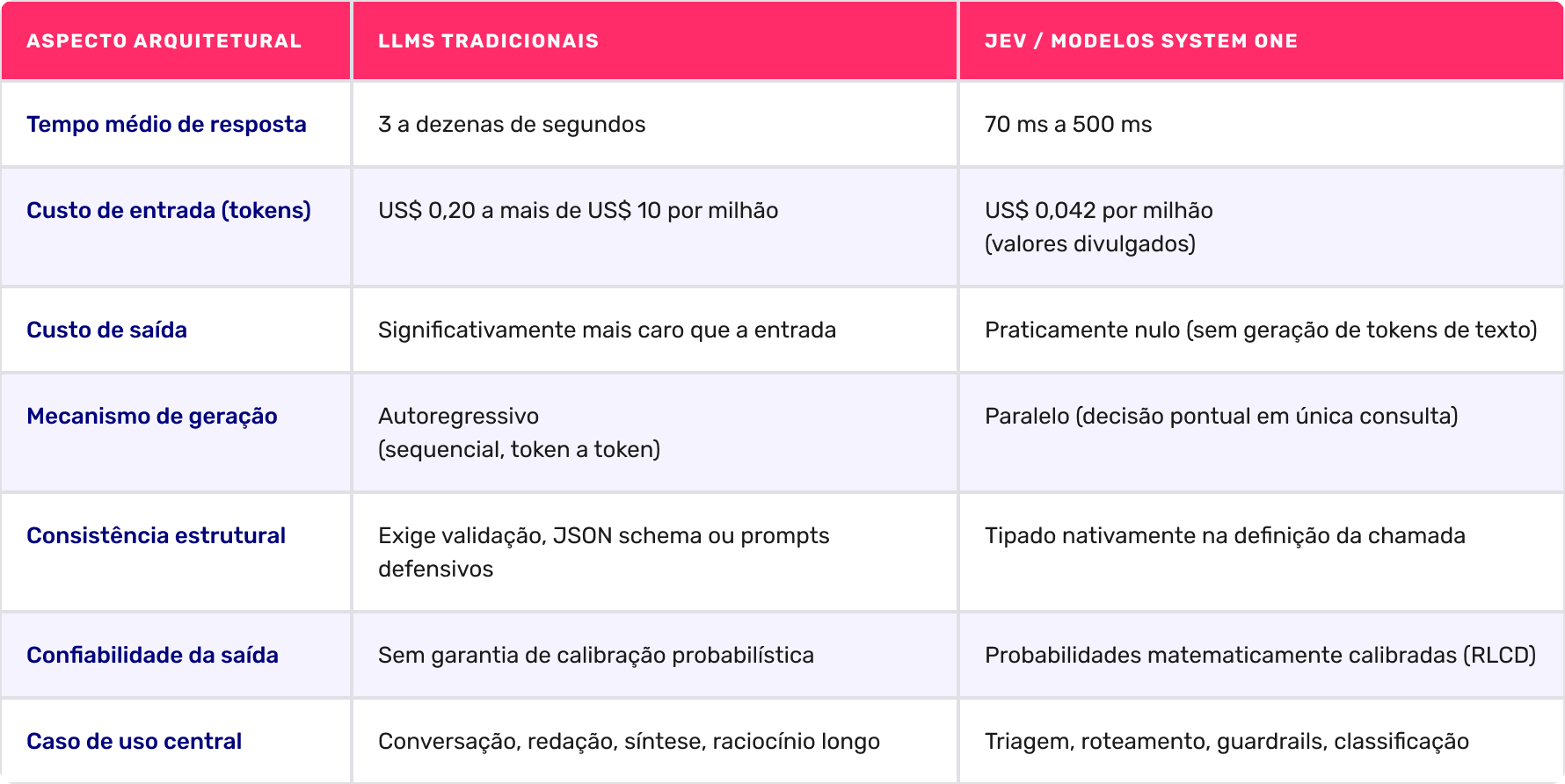
The technical confrontation: LLMs vs. typed decision models
Critical governance perspective*
Benchmarks showing 193x speed and 444x cost gains reported by manufacturers should always be treated as hypotheses, not as final budget data. Evaluations with each company's actual data mass are essential to prove these metrics in production.
Practical case study: ticket triage at scale
To visualize the financial impact of this technical distinction, imagine a corporate customer service or IT operation that processes 2,000,000 tickets per month.
Each ticket contains about 800 tokens of unstructured context (user description, preliminary history, and instructions). The system's objective is purely operational: to assign a category and a priority level.
1. Exclusive LLM approach
The system sends the 800 tokens to a conversational model. In addition to the input cost, the LLM generates about 40 output tokens to formulate the structured response.
Estimated cost: 1.6 billion input tokens (~US$1,600) + 80 million output tokens (~US$400) - US$2,000 monthly;
Operational problem: high latency, dependency on parsers, and occasional failures when the model tries to be helpful and adds unsolicited comments.
2. Exclusive Jev approach
The system submits the ticket with the pre-established closed typing.
Estimated cost: 1.6 billion input tokens - US$0.042 per million - US$67 monthly;
Operational gain: decision delivered in hundreds of milliseconds, consumed directly by the backend without string processing.
Cascading orchestration with the Genius platform
We understand that the answer to efficiency is not architectural radicalism. The mature path lies in cascading architecture with probabilistic fallback.
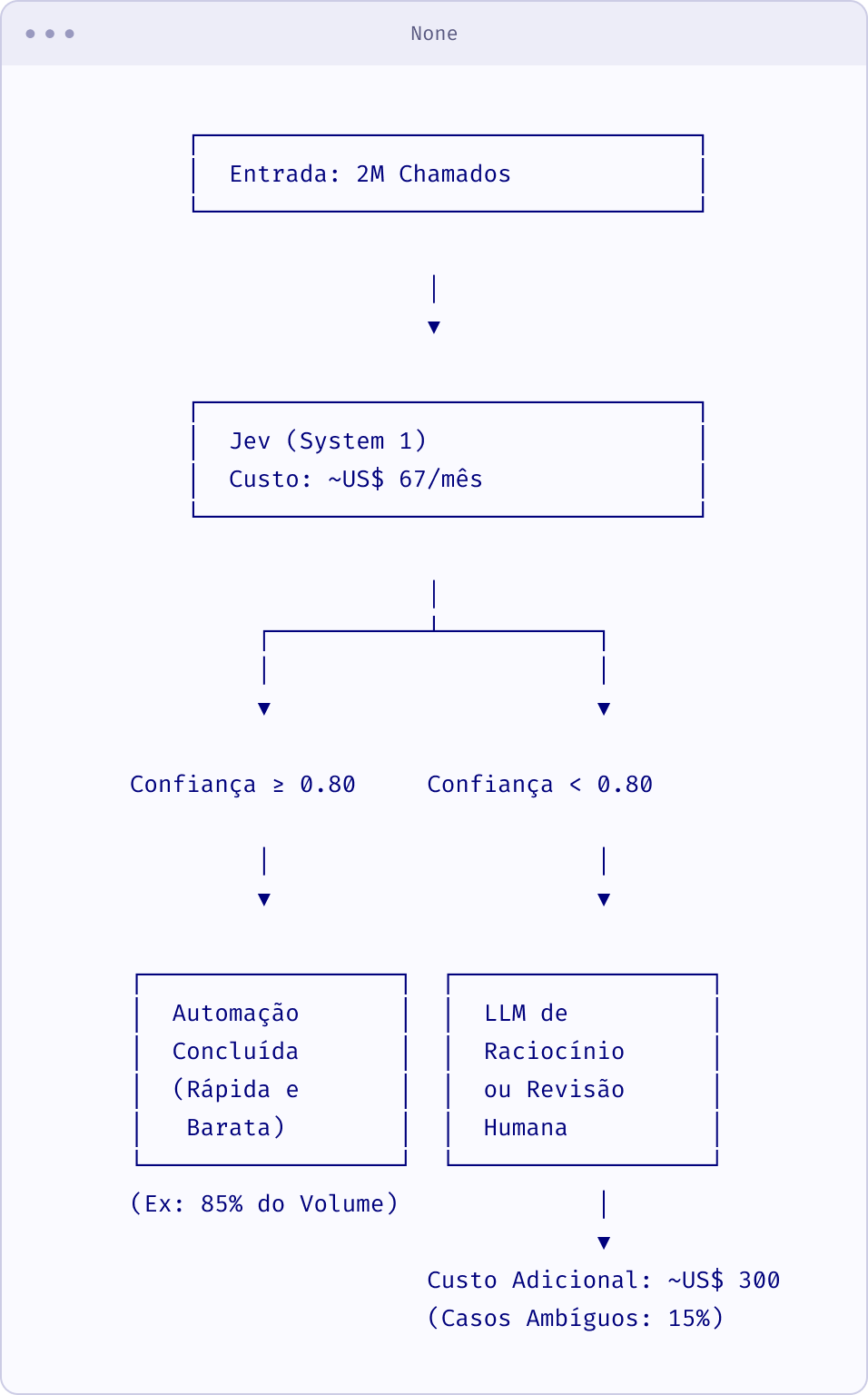
First layer (fast decision): 100% of events pass through the typed decision model (Jev or Laya);
Calibration cutoff: the system analyzes the confidence score associated with the response; if the probability is equal to or greater than an established threshold (e.g., 0.80), the decision is approved and follows the flow automatically;
Second layer (specialized routing): only gray and ambiguous cases (assuming 15% of the volume, or 300,000 tickets) are escalated to a denser and more expensive LLM, capable of interpreting complex nuances.
The financial result
The operation combines the US$67 cost of System One with approximately US$300 for calls directed to the LLM. The total bill comes to around US$370 per month — a sustainable reduction of over 80% in inference costs, while maintaining accuracy and achieving substantial speed gains for most of the traffic.
The technical and business validation framework
For product leaders, CTOs, and solution architects, replacing AI components must be supported by objective criteria. Before migrating any workload to typed decision models, four steps should be executed in a proof-of-concept (PoC) environment:
1. Ground truth labeling
Separate a sample of 300 to 500 real instances from your operation and label them manually.
2. Real calibration test
Evaluate whether the tool's confidence metrics reflect the reality of your Portuguese-language data: does a return with 0.90 confidence actually succeed 9 out of 10 times in your business domain?
3. Measurement of the escalation rate
Find out what percentage of your volume will need to resort to LLM fallback; this rate dictates the real cost of the mixed architecture.
4. Audit and governance
Ensure that each step records the input parameters, the triggered model, the confidence level, and the routing path for compliance and information security purposes.
The corporate artificial intelligence revolution does not lie in the relentless pursuit of the most sophisticated model to solve every type of problem.
True efficiency comes from architectural discipline: using natural language when conversation is mandatory and typed decision when the priority is to decide quickly, with auditability and low cost.
At Squadra, this is the practical essence that guides the development of the Genius AI Platform. We help organizations transform AI potential into a sustainable business lever, ensuring financial predictability, strict governance, and maximum efficiency in every call. Talk to our specialists.