

The cost of HR fragmentation on the business's operating margin
HR operates as one of the biggest bottlenecks for unstructured data in business, and yet, its processes rarely enter the board's radar as a threat to profit margins and compliance.
The core problem is functional isolation. While other areas of the company operate under agile workflows, HR often survives as a transactional island.
Data entering through recruitment does not communicate fluidly with other corporate systems, occupational health reports remain trapped, and contractual changes depend on manual screenings that take weeks.
The fallacy of the omnipresent ERP and the fracture of the back office
Historically, the standard answer from CIOs to solve people management was to centralize everything within the corporate ERP. The promise of a single platform, however, clashes with the nature of human workflows, which are dynamic, document-intensive, and dependent on external validations.
This type of system was designed as a deterministic record for audit and financial control. It was not designed to interpret the semantics of a medical certificate issued in irregular handwriting, compare contractual addendums with current powers of attorney, or orchestrate the mobilization of third parties with real-time verification of certificates.
This architectural gap forces analysts to act as human bridges: they receive files by email, visually interpret supporting documents, manually enter registration information into the ERP, and perform checks in parallel spreadsheets.
From screening to termination: friction at every stage of the employee lifecycle
The disconnect between corporate areas is mainly manifested in the documentary workflow that accompanies the employee's life cycle as a sequence of cumulative operational bottlenecks:
Talent acquisition
Resume screening and job description continue to consume hours of experienced recruiters in manual profile matching tasks, delaying time-to-hire for strategic positions.
Hiring and onboarding
The average hiring process requires collecting, checking, and validating up to twenty documents (ID card, CPF, titles, proof of address, diplomas, certificates). Manual verification generates chronic rework and can frustrate the new employee right from the first corporate contact.
Continuous operational management
Processing of periodic exams, medical certificates, leaves of absence, third-party mobilization, and variable calculations for payroll closing. The lack of integration with legal and finance departments means that changes in benefits and contractual addendums take a long time to reflect in cash flow forecasts and ancillary obligations.
Termination and compliance
Rescission calculation requires cross-checking of homologation terms, vacation history, individual agreements, and settlements. Occasional typing errors or date discrepancies directly feed the company's labor contingency portfolio.
Contextual AI and overcoming the unstructured data barrier
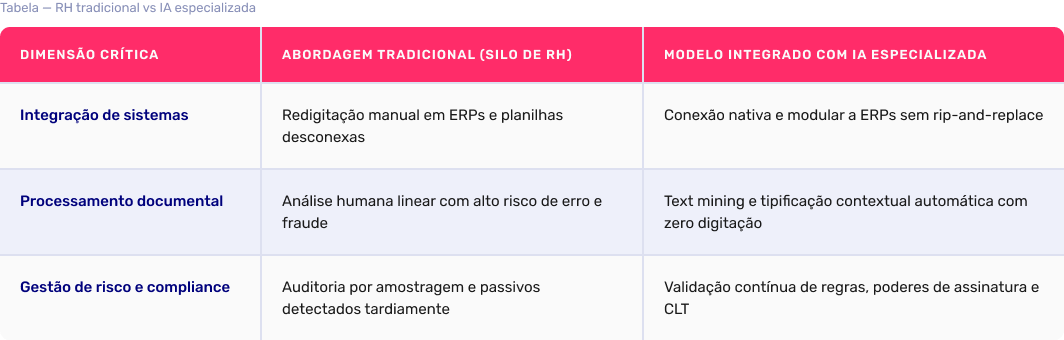
The modern engineering response is intelligent coexistence: applying modular artificial intelligence agents designed to extract, classify, and structure unstructured data directly at the input layer, integrating with legacy systems via APIs.
It is imperative to distinguish generic AI models from specialized engines for transactional documents.
Generalist public models operate on broad syntactic probabilities but fail to interpret legal and operational nuances. In daily corporate routines, the same date on a document can represent the issuance date of a credential, the validity of an agreement, or the holder's date of birth.
Text mining engines trained for contractual and regulatory scenarios understand business semantics. They can read a hiring document, automatically identify the holder, validate data authenticity, check pending items, and orchestrate data loading into the ERP without any analyst needing to transcribe a single line of information.
Rupture-free architecture: governance, security, and return on investment
First, data security and regulatory compliance with LGPD are mandatory. Systems dealing with personal data cannot expose sensitive information for public model training or violate corporate security perimeters.
Orchestration through AI must allow the use of models already approved by the company's internal infrastructure or run in dedicated environments with strict access governance.
Second, the contemporary approach is based on agile and modular setup. Automation is implemented at the most critical bottleneck—often digital hiring or certificate validation—achieving measurable ROI in a few weeks before expanding to adjacent steps.
The HR back office is no longer an unavoidable expense center but has become a tactical lever for operational efficiency.
As long as the organization keeps its qualified professionals dedicated to typing certificates and manually chasing forms, it will be subsidizing inefficiency with resources that should fund innovation and strategy.
How much capital will your company continue to drain until it decides to integrate the back office with the rest of the business. Talk to our specialists and learn about Squadra People Flow, AI-powered automation for HR processes.