Loading
About this episode
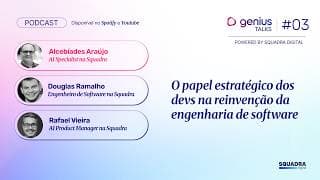
In the fourth episode, host Alcebíades Araújo, AI Specialist, welcomed Rafael Vieira, AI Product Manager at Squadra, and Douglas Ramalho, Software Architect and Engineer at Squadra, to show, in practice, the impact of AI on the development cycle, end-to-end, from discovery to deploy.
Description
AI has come to revolutionize, to reinvent software engineering. And the power of this technology lies not in the ability to write many lines of code, but in the ability to add context. This was the theme of our previous episode of Genius Talks, about the reinvention of software engineering and the engineer's role in it all.
In the fourth episode, host Alcebíades Araújo, AI Specialist, welcomed Rafael Vieira, AI Product Manager at Squadra, and Douglas Ramalho, Architect and Software Engineer at Squadra, to show, in practice, the impact of AI on the development cycle, from end to end, from discovery to deploy.
Every development process begins in the discovery phase, the discovery. Regardless of the business, it is in this phase that we uncover the client's pain points and what we truly need to solve to generate value.
In this phase, artificial intelligence adds all the context surrounding the business. The integral design methodology allows us to map internal and external factors, uncover inputs and outputs, understand processes, and define the structure that will support the entire solution for years to come.
Hyper-productivity arises from AI's ability to add business context and no longer lose this knowledge base, which is transferred to intelligent agents and pre-trained models. In a later stage of the development cycle, or even in another similar project, we can reuse what the AI has learned and no longer redo it from scratch, as was common in software engineering before the advent of AI.
When it comes to design, pre-trained models already know exactly the path they should follow because, in addition to the knowledge base stored in intelligent agents, the particularities and individualities of each business are mapped, with active listening from various stakeholders within the final client, and incorporated into the final context that will guide the AI.
“We create pre-trained models that already carry the history of the scenario you are in, and these models are still fed with the client's dynamics, taking the most universal characteristics and adding the client's context,” says Douglas Ramalho.
If the constant presence of humans in co-creation with AI was already essential in the previous stages, from here on it is a prerequisite.
As we've said here, AI has immense code generation capabilities, but the software engineer and architect, who are the people with technical knowledge, cannot allow it to generate all the code alone.
At this point, it is important to apply observability and explainability. Throughout the code creation process, AI cannot make decisions on its own. The developer needs to constantly observe what it is producing and demand that it explain the reasoning behind each of its decisions. Only in this way can we ensure that the code is secure enough to be applied, for example, in a critical scenario, such as a hospital system where an error can determine a person's life.
“AI needs to ask you questions. You don't want it to do everything by itself; you want it to interact with you when necessary. We need to be very aware to do things in the best way and not cause any harm,” says Douglas Ramalho.
When you follow all the stages of the development cycle in a structured and organized manner, co-creating with AI, with the technical team, and with the client, many problems will have already been solved by the time of deploy. Business rules, general context, and the client's environment will have been mapped, and all of this will have been part of the pre-trained model's conception in the earlier stages.
Check out the full discussion on YouTube, Spotify, Apple Podcasts, and Deezer.

Social impact in global health with AI | Genius Talks #06