Loading
About this episode
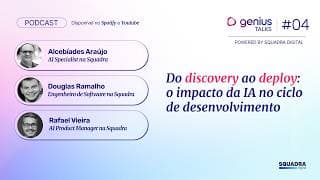
In the third episode of Genius Talks, host Alcebíades Araújo, AI Specialist, welcomed Rafael Vieira, AI Product Manager at Squadra, and Douglas Ramalho, Software Architect and Engineer at Squadra, to discuss how this technical disruption is redesigning roles in the software development ecosystem.
Description
Contrary to early apocalyptic predictions that artificial intelligence would eliminate the need for programmers, the market has witnessed the opposite phenomenon: AI is demanding more engineering. However, it is a fundamentally different engineering, one that has migrated from serialized coding to a more contextual, relational, and strategic role.
In the third episode of Genius Talks, host Alcebíades Araújo, AI Specialist, welcomed Rafael Vieira, AI Product Manager at Squadra, and Douglas Ramalho, Software Architect and Engineer at Squadra, to discuss how this technical disruption is redesigning roles within the software development ecosystem.
For decades, software development has been based on purely deterministic logic, but in the face of large language models (LLMs) and neural networks managing hundreds of billions of parameters, the rules have changed.
As Douglas Ramalho explains, traditional unit tests, while still valuable, are no longer sufficient:
“How do I create a unit test for a decision that is more tied to probability than determinism? It alone no longer guarantees that the solution will behave as expected.”
The ease with which tools generate colossal volumes of code creates a paradox: producing too much without proper control can inflate repositories with hidden flaws or vulnerabilities. It is in this scenario that the software engineer assumes the noble role of AI tutor and curator.
From a business perspective, AI acts as a powerful cognitive amplifier. Rafael Vieira highlights that the alignment and documentation processes, in the discovery phase of software development, which historically generated friction between product teams and technical teams, have gained unprecedented speed:
“Today, it’s already a reality within the group: we’ve optimized over 70% of the time in a discovery and documentation process.”
However, this gain only translates into sustainable value if there are clear operational guardrails. Without explicit boundaries of action, LLM-based solutions tend to hallucinate and deviate from the client’s business objectives.
To mitigate these risks and structure human consciousness in a machine-readable format, the integral design methodology divides any problem or platform into four fundamental models:
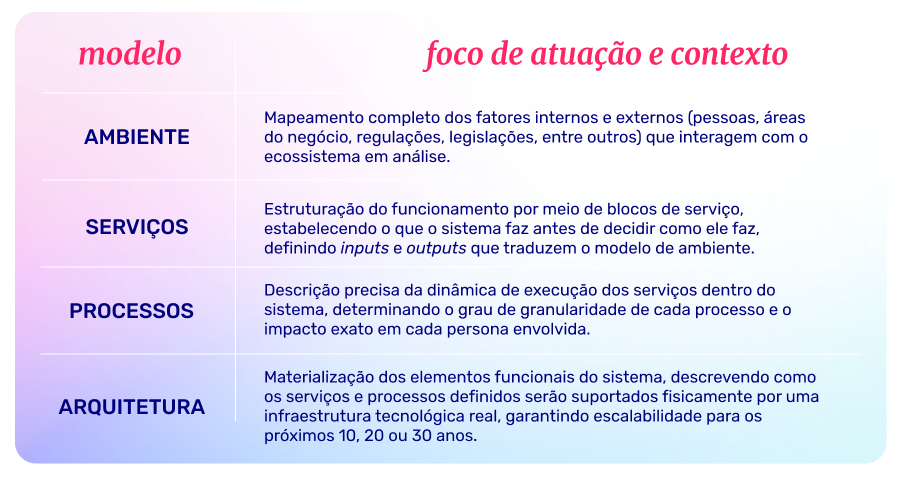
Instead of trying to force-fit the client’s pain points into a rigid computational model, integral design brings together business professionals, managers, and developers around the context and translates it into a common semantic language.
The pinnacle of this transformation is the birth of turing bots. In a company with over 35 years of market experience like Squadra, reusing the accumulated knowledge from the various verticals it has served throughout its history, such as health, logistics, insurance, and finance, has always been a costly and slow cataloging challenge.
Turing bots solve this problem. They operate as intelligent agents with well-documented inputs, outputs, and purposes. Integrated into a hybrid collaborative network, these agents themselves identify and suggest which components can accelerate the resolution of a specific client pain point.
The future of software engineering has abandoned superficial linear writing to consolidate into an integrated socio-technical ecosystem, where human talent is freed to create, orchestrate, and thrive alongside technology. In AI-reimagined software engineering, the developer is never alone again.
Watch the full discussion on YouTube, Spotify, Apple Podcasts, and Deezer.
00:00 - 00:52 | Introduction
00:53 - 06:00 | How AI is reinventing software engineering
06:01 - 09:52 | The collapse of traditional concepts
09:53 - 13:56 | From developer to AI tutor
13:57 - 16:29 | Optimization in discovery and the dangers of hallucination
16:30 - 21:08 | The risks of autonomous systems and human in the loop
21:09 - 27:55 | The integral design method and the four knowledge models (environment, services, processes, and architecture)
27:55 - 36:26 | The end of commodities and the era of turing bots
36:27 - 39:43 | Closing

Social impact in global health with AI | Genius Talks #06