Loading
About this episode
AI's true disruption happens when it crosses the boundaries of corporate digital solutions and directly impacts people's lives on a global scale.
Description
The true disruption of AI happens when it transcends the boundaries of corporate digital solutions and directly impacts people's lives on a global scale.
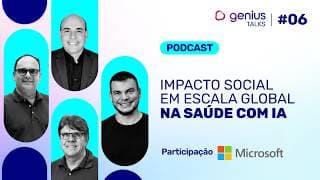
In the latest episode of Genius Talks, our host, Alcebíades Araújo, AI Specialist at Squadra, welcomed Hugo Marques, SMB & Partner Leader & Board Member at Microsoft Elevate, Romulo Cioffi, Chief AI and Innovation at Squadra, and Douglas Ramalho, Software Engineer at Squadra, for a conversation about what makes an AI project thrive in business and society, breaking through market boundaries to impact people's lives.
According to a McKinsey report released at the end of 2025, about 80% of AI initiatives still get stuck in the proof-of-concept (PoC) phase and fail to cross the bridge towards scaling.
For Hugo Marques, the explanation for this gap lies in the incorrect division of weight given to the elements of an AI project:
"If we analyze projects that truly generate impact, success is divided into: only 20% is related to the chosen language model (LLM); 40% corresponds to governance, integration, and data quality; and the other 40% of success depends purely on the process, which involves security, monitoring, and team training." - Hugo Marques, SMB & Partner Leader & Board Member at Microsoft Elevate.
Romulo Cioffi adds that integral design, Squadra's actionable methodological approach that transforms real business problems into structured contexts for LLMs, ensures the successful integration of LLM, data, and process.
To illustrate how this flow translates into practice, Hugo shared a personal experience from a public school in the United States where his children study.
The school principal needed to fix the 3D printers in the school's lab. Behind this, there was a chronic problem, common in many other public schools in the country: she spent an average of 35 hours per week trying to structure budgets, legal data, and complex documentation to request funds from private institutions (grants) that help the school in such cases.
After understanding the origin of the problem, which was a vital school process, the executive designed an architecture of multiple intelligent agents focused on each of the steps in the grants process, coordinated by a central orchestrator and maintained by active human curation.
The tool automated a broken process, and instead of hours, the principal now takes minutes to structure the necessary documentation for the grants process. The success was so great that the solution is now within the Microsoft Marketplace to help other public schools.
Unlike past technological waves (such as the emergence of mobile phones or broadband internet), which accentuate development gaps between different regions of the world, AI is intrinsically flat and fluid. It distributes intellectual wealth and includes more people in the innovation game.
Hugo Marques provided an impactful example of this reality: his NGO, which operates in Kenya, Nairobi, provides young people aged 15 to 17 with more advanced tools than those available in top US universities.
AI is not here to eliminate positions, but to reposition people and companies. It is the end of purely threatening narratives and the beginning of an era focused on deep knowledge of the problem, the solution process, the role of technology, and, above all, the real impact on communities.
APIs in the Probabilistic Universe of AI | Genius Talks #07